
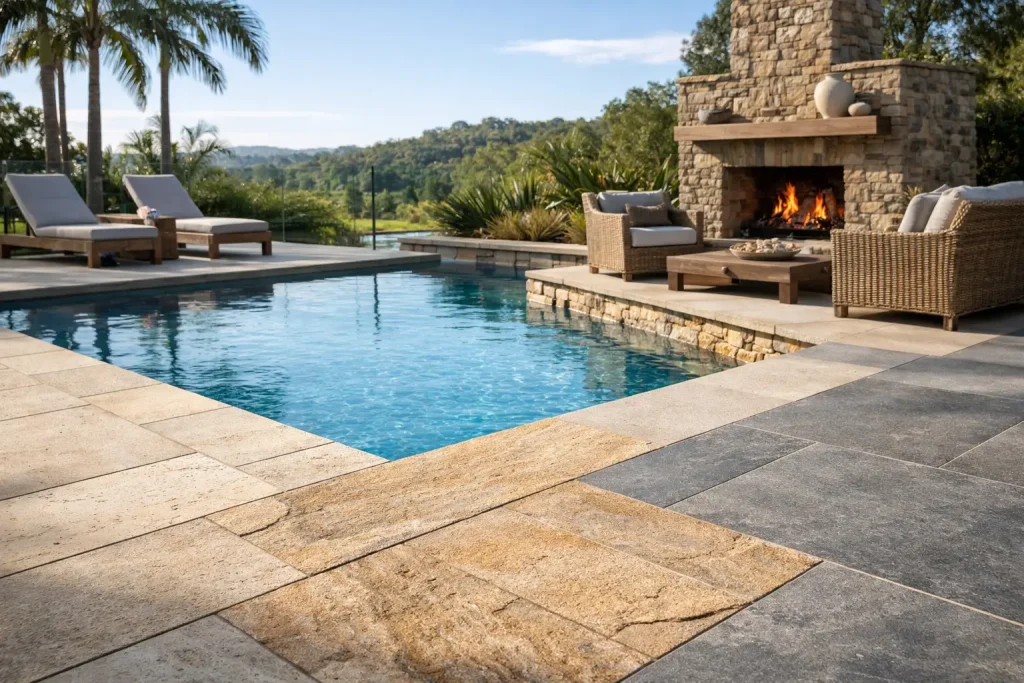
Bare feet tell the truth fast. A pool surround can look immaculate in a showroom or on a finished landscape plan, but if it gets too hot underfoot, turns slippery after a swim, or shows every mark from salt and sunscreen, the finish quickly loses its appeal. Choosing the best stone for pool surrounds is really about getting performance and design to work together.
Around a pool, the surface has to do more than frame the water beautifully. It needs to stay comfortable in full sun, offer good slip resistance, cope with constant moisture, and hold its colour and character over time. For design-led homes, it also needs to connect the pool area to the wider material palette – the house, the garden, the coping, the outdoor shower, and the alfresco zone.
What makes the best stone for pool surrounds?
The short answer is that there is no single stone that suits every project. The best choice depends on exposure, pool type, maintenance expectations, and the overall architectural direction of the home.
That said, there are a few qualities that matter almost every time. A good pool stone should have a naturally cooler feel underfoot than darker dense surfaces, enough texture to improve grip without becoming abrasive, and the durability to handle water, cleaning products, and outdoor conditions. If the pool is salt chlorinated, material selection becomes even more important, as some stones perform better than others in saline environments.
Aesthetics matter just as much. Pool surrounds occupy a large visual field, especially in contemporary homes where the pool and outdoor entertaining area are designed as one continuous living space. The stone should not fight the water colour, the façade, or the landscaping. It should make the whole setting feel resolved.
The best stone for pool surrounds by material type
Travertine
Travertine remains one of the most popular answers to the question of the best stone for pool surrounds, and for good reason. It has a soft, timeless character that works across Mediterranean, coastal, contemporary and resort-style homes. Underfoot, it is often more comfortable than many denser stones, particularly in lighter tones.
Its naturally pitted texture also helps create a more forgiving, less slick surface when specified in the right finish. Tumbled and honed-and-filled options each create a different look, so the exact selection matters. Tumbled travertine tends to feel more relaxed and traditional, while cleaner cut formats suit more architectural schemes.
The trade-off is maintenance. Travertine is a porous limestone, so sealing is usually recommended, and ongoing care matters if you want to minimise staining from leaves, sunscreen, food and drinks. In the right project, that extra maintenance is a worthwhile exchange for warmth and visual softness.
Limestone
Limestone is another strong contender for premium pool areas. It offers a refined, quiet surface with a more tailored appearance than heavily textured stone, making it particularly well suited to modern landscapes and homes with restrained palettes.
Many limestones sit beautifully with pale renders, timber accents, brushed metals and soft planting. They can create a calm, elevated feel that lets the water become the focal point. Lighter limestone can also perform well in terms of heat compared with darker paving materials.
As with travertine, the key consideration is porosity and maintenance. Not all limestone is equal, and some varieties are better suited to wet outdoor applications than others. Finish is critical too. Around a pool, you want a surface that offers enough grip while still feeling sophisticated rather than overly coarse.
Sandstone
For a more natural Australian landscape expression, sandstone often makes sense. It has an organic grain, easy warmth, and a relaxed character that suits traditional homes, bushland settings, and coastal properties. It can soften the transition between built space and garden very effectively.
Sandstone is often comfortable underfoot in sunny conditions, especially in lighter shades. Visually, it tends to feel less formal than limestone and less resort-like than travertine, which can be exactly right for some projects.
Its softer composition can be both a benefit and a limitation. It is easier to create a tactile surface, but some sandstone varieties may weather or mark more readily depending on density, finish and site conditions. Good specification matters, especially around heavily used family pools.
Granite
Granite is chosen less for softness and more for strength, consistency and contemporary presence. It is dense, durable and highly suited to projects where longevity and a sharper architectural line are priorities.
The caution with granite is heat. Darker granites can become very hot in full sun, which can make them less pleasant around exposed pool zones. Lighter granites improve that issue, but granite generally has a denser, harder feel than stones like travertine.
Texture also matters here. Highly polished granite is not appropriate for pool surrounds, but flamed or textured finishes can provide the necessary slip resistance. If the home has a clean, monolithic material palette and the pool area includes shade structures or partial cover, granite can work extremely well.
Bluestone
Bluestone has a strong design following in Australian architecture, particularly where a project calls for depth, contrast and a more grounded material language. It can look exceptional in contemporary landscapes, especially when paired with crisp planting, dark metalwork and minimal detailing.
For pool surrounds, however, bluestone needs careful thought. Darker tones absorb more heat, so in open sunny settings it may become uncomfortable under bare feet. It can also show salt and mineral deposits more visibly in some contexts.
That does not rule it out. In shaded courtyards, plunge pool zones, or homes where the pool is more of a sculptural feature than a broad family recreation space, bluestone can be the right visual move. It is simply less forgiving in full-sun, high-traffic applications.
How finish changes performance
When people ask about the best stone for pool surrounds, they are often focused on stone type alone. In practice, finish is just as important.
A stone that looks beautiful indoors may be entirely wrong outdoors if the surface is too smooth. Around a pool, the ideal finish usually balances grip with comfort. It should feel stable when wet, but not rough enough to be unpleasant on bare feet or difficult to clean.
Honed, tumbled, brushed and sandblasted finishes all create different results. The right choice depends on the stone itself, the style of the project and how the space will be used. A family pool used daily by children needs a different level of practicality than a compact courtyard pool attached to a design-focused entertaining area.
Design considerations beyond the paver itself
Pool surrounds are rarely just paving. The final result depends on how the stone works with coping, waterline tiles, drainage, planting and adjacent living zones.
If the coping and paving are too similar in format and tone, the pool edge can disappear visually. That can be elegant in some contemporary projects, but in others it makes the pool feel unresolved. Likewise, if the paving stone clashes with the waterline tile, the water can read dull or muddy rather than clear and inviting.
Scale matters too. Larger format pavers usually create a more contemporary look with fewer joints, while smaller modules feel more classic or textural. Joint spacing, edge detailing and transitions into grass, decking or pathways all shape the overall feel. The best pool surround stone is not just good in isolation – it works as part of a complete outdoor material story.
Practical questions to ask before you choose
A few early decisions can narrow the field quickly. Is the pool in full western sun or partly shaded? Is it a saltwater pool? Will the area host regular entertaining, or is it more of a quiet retreat? Are you after a resort mood, a coastal palette, or something more architectural and pared back?
Maintenance tolerance should be discussed honestly. Some clients are happy to reseal natural stone and accept the gentle patina that comes with outdoor living. Others want a surface that asks less of them. Neither approach is wrong, but it will influence the best material choice.
For homes across Brisbane, the Gold Coast, Sunshine Coast and Northern Rivers, climate exposure is another real factor. Strong sun, humidity, storms and leaf matter all place demands on outdoor surfaces. That makes product quality and correct specification far more important than simply choosing a stone from a photograph.
So, which stone is best?
If comfort, broad design appeal and a luxury outdoor feel are the priority, travertine is often the leading choice. If the brief leans more refined and architectural, limestone can be exceptional. If you want an easy connection to natural Australian landscaping, sandstone is often a strong fit. Granite and bluestone suit more specific visual and performance briefs, but they usually require tighter planning around heat and finish.
The strongest pool spaces are rarely built around a trend piece. They come from choosing stone with a clear understanding of how it will look at midday, feel after a swim, and age over years of sun, water and use. When that choice is made well, the pool surround stops feeling like a surface selection and starts feeling like part of the architecture itself.
If you are weighing up samples, place them in direct sun, wet them, walk on them barefoot, and look at them next to the rest of your exterior palette. The right stone usually reveals itself in those practical moments, not just on a mood board.