
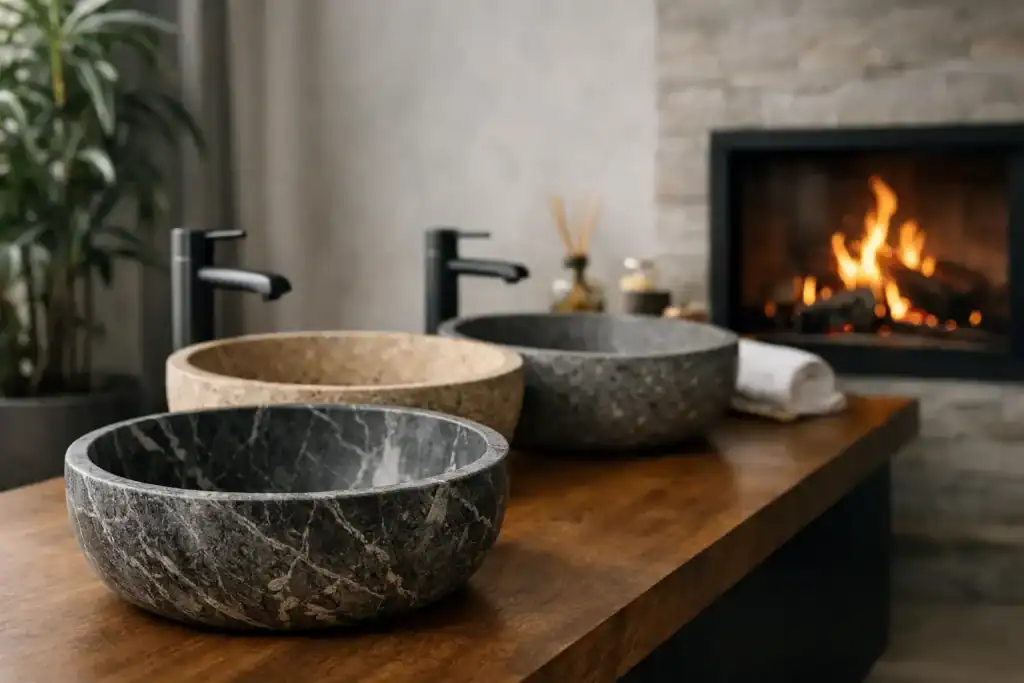
A stone basin can make a room feel resolved in an instant – not because it is louder than everything else, but because it brings weight, texture and permanence. If you are working out how to choose stone basin options for a new build, renovation or landscape project, the best place to start is not colour. It is context. The right basin should suit the way the space is used, the scale of the vanity or benchtop, and the wider material palette around it.
Stone basins are often chosen for their visual impact, yet the most successful selections feel considered rather than decorative. In a powder room, a carved basin can become the hero. In a family bathroom, it needs to look refined while still being easy to live with. In an outdoor setting, it must hold its own against sun, moisture and shifting temperatures. That is where thoughtful selection matters.
How to choose stone basin with the room in mind
Every basin sits within an architectural composition. Before comparing profiles or finishes, step back and assess the room itself. A compact ensuite usually benefits from a basin with a lighter visual footprint, while a generous main bathroom can carry more volume and sculptural detail. If the basin is too large, the vanity can feel crowded. Too small, and the whole arrangement can look underdone.
It also helps to think about who will use it every day. A guest powder room gives you more freedom to prioritise form. A busy household bathroom asks for a little more practicality – enough internal bowl space, manageable splash control and a surface finish that does not demand constant attention.
For designers and renovators aiming for cohesion, the basin should also connect with the other hard finishes in the space. That does not mean everything needs to match. It means the basin should feel intentional beside the floor tile, wall finish, tapware and joinery. A softly honed limestone basin can sit beautifully in a tonal, natural scheme. A darker marble or basalt basin may suit a sharper, more architectural interior.
Material matters more than many people expect
Not all stone basins perform in the same way, and appearance is only part of the story. Density, porosity, veining and finish all affect day-to-day use.
Marble offers richness and movement that can elevate a bathroom immediately, but it is generally more porous and may be more reactive to certain products if not properly sealed and maintained. Travertine has warmth and character, though its natural pitting and texture may not suit every application. Granite and basalt tend to feel more durable and grounded, often appealing where a cleaner, more minimal expression is required. River stone basins bring a strong organic quality, but each piece is inherently individual in shape, depth and edge detail.
This is one of the main trade-offs to weigh up. The more natural variation a stone has, the more personality it brings. It can also mean less predictability from piece to piece. For some projects, that individuality is exactly the point. For others, especially where multiple basins need to align closely, a more controlled material may be the better fit.
If you are selecting from a showroom floor, look closely at the actual piece where possible. Tone variation, veining and edge detail can shift the feel from calm and refined to dramatic and statement-led.
Shape changes both the look and the function
Basin shape is not just a styling choice. It affects how the basin sits in the room, how water behaves inside it and how comfortable it is to use.
Round and oval basins tend to soften a scheme. They work well in spaces where there are already strong linear elements from vanities, mirrors and tiles, because they introduce balance. Rectangular and square basins feel more structured and architectural, often suiting contemporary interiors or outdoor wash areas with cleaner geometry.
Depth matters too. A shallow basin can look elegant, especially in a powder room, but it may create more splash depending on the tapware position and water pressure. A deeper bowl can be more forgiving in everyday use, though it may appear heavier on a slim vanity.
Edge treatment is another subtle but important detail. Crisp edges feel tailored and modern. Softer carved forms feel more organic and relaxed. Neither is better in absolute terms – it depends on the language of the project.
Vessel, inset or integrated feel
Most stone basins used in design-led residential spaces are vessel style, sitting above the benchtop as a sculptural element. This creates presence and allows the material to be appreciated from more angles. It also raises the overall basin height, which needs to be considered early so the vanity does not end up too tall.
If you want a quieter outcome, a lower-profile form or semi-recessed look may suit better. The key is proportion. A basin should feel anchored to the vanity, not perched on it as an afterthought.
Size and proportion are where good selections become great ones
One of the most common mistakes is choosing a basin in isolation. A beautiful basin can still look wrong if the proportions are off.
Start with the vanity width and depth. Allow enough room for the basin to sit comfortably while leaving practical landing space around it. In smaller bathrooms, this balance becomes more critical. An oversized basin may dominate the benchtop and leave little room for daily use. In a larger setting, a basin that is too slight can feel visually lost.
Height is just as important. Because stone basins often have thicker walls than ceramic alternatives, they can carry more visual mass. That can be an advantage in a luxurious scheme, but it should be matched to the scale of the joinery and mirror above.
For double vanity arrangements, consistency matters. If the room is formal and symmetrical, closely matched basins create order. If the scheme is more relaxed or highly customised, subtle natural variation may add character without compromising cohesion.
Finish, texture and maintenance
A honed finish usually feels softer and more understated than a polished one. It suits natural, layered interiors and tends to show the stone in a more relaxed way. Polished finishes can bring depth and reflectivity, particularly with richly veined materials, but may read as more formal.
Textured or hand-finished exteriors can be striking, especially in powder rooms or outdoor applications where you want the basin to feel carved rather than manufactured. Internally, though, smoother surfaces are often easier to clean and more practical for everyday use.
This is where realism helps. Stone is a natural material, and it asks for appropriate care. Sealing, cleaning products and long-term maintenance should be part of the decision, not an afterthought. If the client or household wants a basin that hides all signs of use, certain stones and finishes will be more forgiving than others. If they are happy to embrace a material that develops character over time, the options widen.
Tapware, drainage and installation should be considered early
The basin and tapware need to work as a pair. A tall mixer may suit a vessel basin, but the spout reach and angle must align with the bowl to avoid awkward splash or poor usability. Wall-mounted tapware can create a clean, architectural look, though it requires earlier planning and accurate set-out.
Waste placement and plumbing access also matter, especially with custom joinery. Natural stone basins can be heavy, so the vanity or benchtop needs to support the load properly. This is particularly important in larger-format designs or where the basin itself is substantial in thickness.
For outdoor bathrooms or open-air wash zones, drainage, weather exposure and surrounding surfaces become even more relevant. A basin that looks beautiful indoors may not be the ideal choice in a fully exposed setting. Material suitability should always be checked against the conditions of the site.
How to choose stone basin for a cohesive luxury result
The most convincing spaces do not rely on one hero item alone. A stone basin works best when it speaks to the broader design language of the home or landscape. In a project that already uses natural stone flooring, wall cladding or paving, the basin can help carry that material story through in a more intimate way. In homes where fire and water features are both part of the brief, these details often matter even more because the project is being read as a whole, not as a set of isolated selections.
That is why showroom selection can be so valuable. Seeing a basin beside other surface finishes, tapware tones and architectural materials gives a clearer sense of scale and compatibility than a product image ever can. For projects across Brisbane, the Gold Coast, Sunshine Coast and Northern Rivers, that level of material coordination often makes the difference between a basin that simply fits and one that finishes the room properly.
A stone basin should feel like it belongs there – not just because it is beautiful, but because its size, material and form are right for the way the space is meant to live. Choose with that level of clarity, and the result will hold its appeal long after the styling moment has passed.