
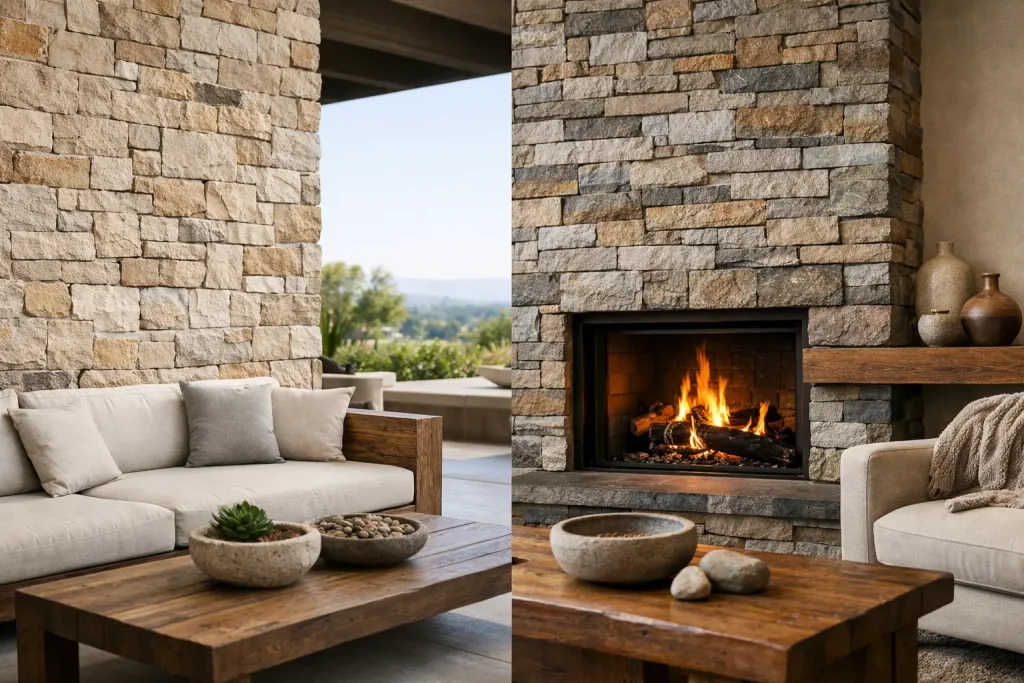
If you have started pricing a feature wall and found one stone at a modest square metre rate while another climbs quickly, you are not imagining it. Natural stone wall cladding price can shift considerably from one project to the next, even when the finished look seems similar at first glance. The material itself matters, but so do format, installation method, wall type and the level of finish you want to achieve.
For design-led homes and landscape projects, wall cladding is rarely just a surface choice. It changes how a facade sits in the light, how an outdoor room feels after dark and how a fireplace or entry statement anchors the rest of the palette. That is why cost should be assessed in the context of the overall result, not as an isolated line item.
What shapes natural stone wall cladding price?
The biggest influence is the stone itself. Dense, premium stones with strong colour consistency, refined splitting and carefully selected faces typically sit at a higher price point than more rustic or widely available options. Imported stones can also carry different freight and handling costs depending on origin, finish and availability.
Format is the next major factor. Loose stone pieces, ledger panels, crazy cladding and large-format cut pieces all price differently because they involve different manufacturing processes and installation time. A panelised product may cost more per unit than a loose format, but the labour can be faster and more predictable. By contrast, a more irregular profile may deliver a highly bespoke look while taking longer to install well.
Quantity also changes the equation. A small fireplace wall often has a higher effective rate than a large boundary wall because set-up, cutting, freight and labour minimums are spread across fewer square metres. That is one reason project quotes can feel inconsistent when comparing a compact interior feature to a full exterior elevation.
Material cost versus installed cost
This is where many budgets go off track. The stone supply rate is only one part of the figure. Installed cost usually includes substrate preparation, adhesive or mechanical fixing systems where required, cutting, corners, sealing if specified, labour, scaffolding or access equipment and waste allowance.
On a straightforward wall with good access, regular dimensions and a simple cladding format, installation can remain relatively controlled. On multi-storey facades, curved walls, detailed fireplace surrounds or areas with numerous returns and penetrations, labour rises quickly. More cuts mean more time. More corners mean more detailing. More complexity means a higher finished rate, even if the base stone cost stays the same.
For this reason, comparing two cladding options purely on material price can be misleading. One may be dearer to purchase but more efficient to lay. Another may look economical until labour and detailing are properly accounted for.
Typical price ranges to expect
Natural stone wall cladding price in Australia commonly starts from around the low hundreds per square metre for entry premium formats and moves upward into several hundreds per square metre for more exclusive stones, complex profiles or heavily curated selections. Installed prices are broader again, often landing well above the supply rate once labour and site conditions are included.
That broad range is not evasive – it reflects how variable stone projects are. A dry-stack style external wall in a readily available stone may sit in a very different bracket to honed cut stone around a fireplace, or hand-laid cladding on a landscaped retaining feature. The same species of stone can also change in price depending on thickness, finish and whether matching corner pieces are needed.
As a practical guide, most premium residential projects should expect to budget for both supply and installation from the beginning rather than trying to add labour later as an afterthought. It produces more accurate decisions early in the selection process.
Why some stone cladding costs more than others
Not all stone is selected for the same reason. Some products are chosen for tonal softness and consistency. Others are selected for movement, texture and geological character. The more controlled and design-specific the selection, the more likely the product sits at a premium level.
There is also a manufacturing difference. Split-face cladding, sawn-backed panels, hand-chiselled edges and custom corner units all involve additional processing. If the project calls for a cleaner architectural expression with tight joints and resolved edges, the stone often needs more refinement before it arrives on site.
Availability matters too. If a stone is held locally in solid stock volumes, that can help with lead times and pricing stability. If it is tied to import schedules or project-specific ordering, cost can fluctuate more. For builders and designers working to a construction programme, that timing can be as important as the square metre rate.
Interior vs exterior pricing
Interior wall cladding is not always cheaper. A fireplace wall, wine room or entry feature may have easier weather conditions than an exterior facade, but it often demands a finer finish. Alignment, edge treatment and transitions become more visible indoors, especially in projects with clean architectural lines and controlled lighting.
Exterior applications can involve larger areas and more forgiving texture, but they introduce different cost factors such as substrate suitability, weather exposure and access. A ground-floor garden wall is one thing. A double-height front elevation with scaffold requirements is another.
Where clients are aiming for continuity between indoors and out, the smartest approach is usually to select stone with both environments in mind from the start. That can create a more cohesive result and help manage pricing across the broader scheme.
The hidden costs worth asking about
Stone cladding quotes are easier to assess when you know what may sit outside the base rate. Freight is a common one, particularly for heavy products or regional delivery. Corners and cappings can be separate line items. Sealers, trims and substrate rectification may also be excluded unless specifically noted.
Waste allowance deserves attention as well. Natural stone is not a sheet product with zero variation. Allowances are needed for cuts, layout and selection, especially on walls with openings or detailed junctions. Trying to trim this too tightly can create delays or batch variation later.
If the site is difficult to access, labour can shift even if the wall area is modest. Long carries, limited storage, upper-level work and restricted trades access all affect installation efficiency. This is particularly relevant on sloping sites and high-end renovations where the home is already partially complete.
How to spend well without flattening the design
The most effective way to manage natural stone wall cladding price is not always to choose the cheapest stone. It is often to apply the right stone in the right place. A hero facade blade wall, fireplace chimney or outdoor entertaining backdrop can carry a premium material beautifully, while secondary walls may suit a simpler finish or a more restrained application.
Scale matters. A small amount of exceptional stone often delivers more impact than a larger area of something chosen only to meet a number. Likewise, choosing a format that suits the architecture can reduce unnecessary cutting and complexity. Clean contemporary homes often benefit from more modular cladding, while organic garden settings can justify a looser, more textural installation.
Early coordination with the builder, designer or landscape architect also saves money. When dimensions, returns and substrate planning are resolved before installation, the result is usually sharper and more cost-efficient.
Getting an accurate quote for wall cladding
Good pricing starts with better information. Square metre area alone is not enough. A useful quote should consider wall elevations, intended stone, corner requirements, site access, substrate type and whether the look is tight-stacked, grouted, random or panelised.
Photos, plans and inspiration references all help narrow the right product and installation approach. If the project includes other feature materials such as paving, pool surrounds or fireplaces, reviewing these together can be valuable. It keeps the material palette coherent and often improves decision-making across the whole project. For clients sourcing in Brisbane, the Gold Coast, Sunshine Coast or Northern Rivers, seeing the stone in person is often the fastest way to understand why one product sits in a different price bracket to another.
Price matters, but wall cladding is one of those selections that stays visible long after the budget spreadsheet is forgotten. When the stone is right for the architecture, the setting and the way you want the space to feel, it earns its place every day.