
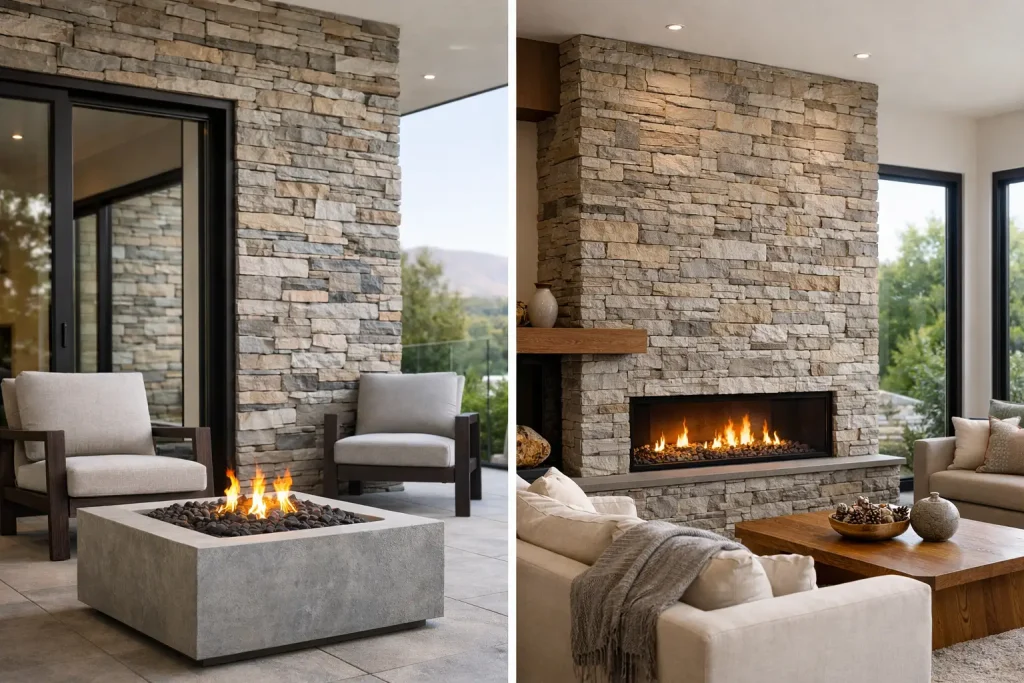
A blank wall can flatten an otherwise well-resolved home. Stone wall cladding panels change that quickly. They introduce depth, shadow and material character in a way paint and render simply cannot, while still working across contemporary, coastal, resort-style and more grounded architectural schemes.
For design-led residential projects, the appeal is not only visual. Cladding panels offer a practical way to achieve the presence of stone without the same installation complexity as full bed masonry. Used well, they create a stronger connection between architecture and landscape – something especially valuable when a home is trying to balance built form with the natural warmth of earth, fire and water.
Why stone wall cladding panels remain in demand
Natural stone has an authority that manufactured finishes often struggle to replicate. It catches light differently through the day, reveals tonal variation up close and gives a space a sense of permanence. Panels make that look more accessible across a broader range of applications, from entry statements and garden walls to fireplaces, pool zones and interior feature walls.
They also suit the way many projects are now designed. Homeowners and specifiers want materials that feel premium but are still practical to specify, quote and install. Stone wall cladding panels answer that brief neatly. They can help streamline labour, support a cleaner architectural finish and allow larger areas to be clad with a more consistent result.
That said, not every project benefits from the same stone profile or layout. A heavily split, rugged finish may be perfect for an outdoor retaining wall or fireplace surround, but too visually busy for a quiet interior living room. Likewise, a slim linear format can feel elegant on a facade, yet slightly cold if the rest of the material palette lacks warmth.
Where stone wall cladding panels work best
The strongest applications are usually the ones that treat stone as a focal material rather than background filler. An entry wall, for example, can gain a sense of arrival from textured stone, especially when paired with timber, planting and considered lighting. Around an outdoor entertaining area, cladding can help tie together paving, a fireplace and pool coping into one coherent scheme.
Inside the home, feature walls are the obvious choice, but they are not the only one. Stone behind a fireplace creates visual weight and anchors the room. In a stairwell or double-height void, it can add scale and restraint at the same time. Even in bathrooms, the right stone can introduce a calmer, more grounded atmosphere, provided moisture exposure and sealing requirements are properly addressed.
Exterior use tends to be where panels show their versatility best. Facades, boundary walls, alfresco kitchens and garden structures all benefit from the texture and tonal movement of natural stone. In Queensland and northern New South Wales conditions, that indoor-outdoor continuity matters. Materials need to feel resolved from the front elevation through to the pool area and outdoor living spaces.
Choosing the right stone wall cladding panels
The first decision is usually aesthetic, but it should not be the only one. Colour, format and texture all shape the final look, yet performance and context are just as important.
A lighter stone can brighten shaded courtyards and soften heavier architecture. Charcoal and deeper grey tones often suit sharper, more contemporary homes, especially when paired with black window frames or darker metals. Warm beige, ivory and sandy blends tend to sit more comfortably within coastal and resort-inspired palettes.
Texture needs careful consideration. Split-face stone creates dramatic shadow lines and a tactile finish, but it can be harder to clean and visually stronger than some spaces require. Honed or more refined profiles feel quieter and often work better indoors. If the goal is elegance rather than rusticity, restraint usually gives a better result.
Panel size and coursing matter too. Larger-format panels can feel more architectural and reduce visual interruption. Smaller or highly modular pieces may suit more traditional or layered designs. The joint pattern should support the architecture, not compete with it.
Natural variation is part of the value
One of the reasons clients choose real stone is that it does not read as flat or uniform. Variation in tone, veining and surface movement gives the material life. In a showroom sample, that variation can look subtle. Across a full wall, it becomes a defining part of the finish.
This is where selection and planning become important. If the project calls for a calm, minimal result, a highly varied stone may not be the right fit. If the design needs warmth and organic character, those tonal shifts are exactly what make the wall feel resolved rather than manufactured.
There is no universal right answer here. It depends on the architecture, adjacent materials and how much visual weight the stone is expected to carry.
Installation considerations that affect the final result
Even a premium stone can look underwhelming if the installation is poorly handled. Substrate preparation, layout planning, edge detailing and transitions all influence the finished appearance.
Corners deserve particular attention. A beautifully clad wall loses credibility quickly if exposed edges feel abrupt or unresolved. The same applies to terminations around openings, fireplaces and external returns. Good design is often visible in these quiet decisions rather than the headline material alone.
Grouting and joint treatment also change the character of the wall. Some panel systems create a more seamless stacked appearance, while others rely on visible joints to define the pattern. Neither is inherently better, but each produces a different architectural language.
For external areas, site conditions matter. Sun exposure, moisture, salt air and surrounding landscaping can all influence product suitability and maintenance expectations. This is especially relevant for coastal projects or homes with pool surrounds, where material compatibility should be considered from the outset rather than after selection.
Stone wall cladding panels and fireplaces
Few pairings feel as natural as stone and fire. A fireplace clad in stone brings texture, substance and a sense of permanence to both indoor and outdoor settings. It can turn a heating element into a true architectural feature.
The key is proportion. A large, heavily textured stone wall around a slim contemporary fire can feel mismatched if the balance is off. Equally, a small-format panel may not provide enough visual scale for a generous fire feature in an open-plan room or alfresco zone.
When these elements are specified together, the broader palette should stay in view. Stone does not need to dominate every surface. It often works best when balanced with cleaner plastered walls, timber joinery, metal accents or soft landscaping.
Maintenance and long-term appeal
Natural stone is durable, but it is not maintenance-free. Some stones benefit from sealing, particularly in wet areas or where staining is a concern. Exterior walls may collect dust, organic matter or mineral deposits over time, depending on their setting.
That should not discourage selection. It simply means the material should be chosen with realistic expectations. A textured stone wall near a garden bed will age differently from a sheltered interior feature wall. In many cases, that weathering adds character. In others, a smoother finish may be the smarter choice.
Long-term appeal often comes down to timelessness rather than trend. Stone wall cladding panels tend to endure because they are materially grounded. They do not rely on novelty. They rely on proportion, texture and considered placement.
What a well-selected stone finish adds to a project
At their best, stone wall cladding panels do more than decorate a surface. They create hierarchy. They help distinguish key moments in a home – the arrival, the hearth, the outdoor room, the garden edge. They bring weight where a design needs grounding and warmth where a space feels too sharp.
For homeowners, that can mean a more valuable and visually resolved property. For architects, designers and builders, it means a finish that supports the overall concept rather than asking for attention on its own. Premium materials should do exactly that.
If you are selecting stone for a new build or renovation, slow the decision down just enough to view it in context. Look at it beside timber, metal, paving, water and fire elements. The best result is rarely about the wall alone. It is about how that wall helps the entire project feel complete.