
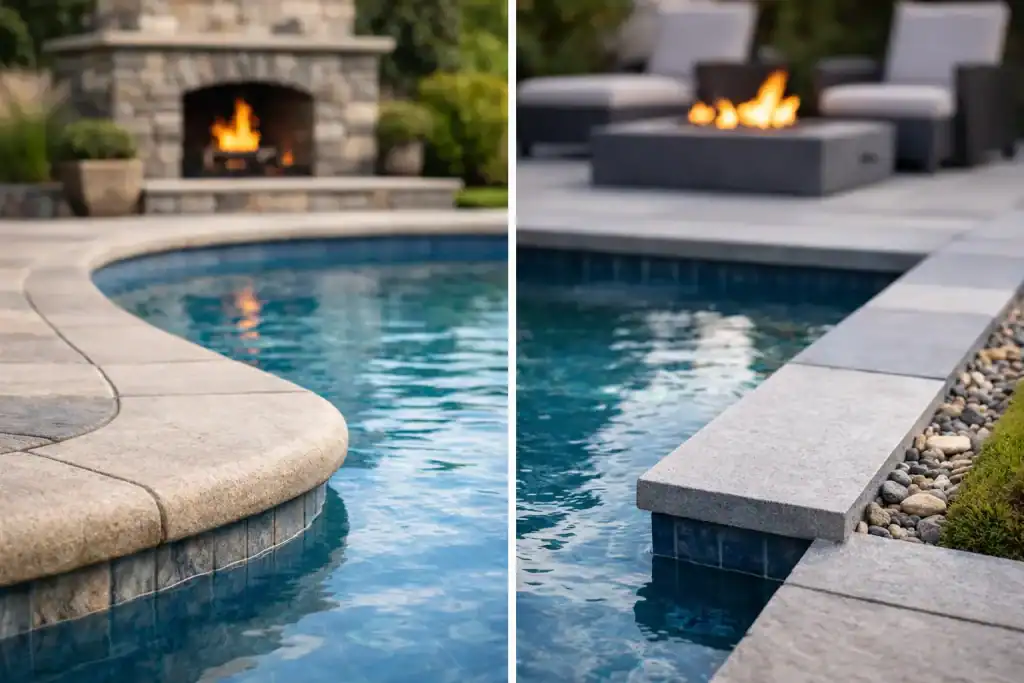
The line where water meets stone does more than frame a pool. It affects how the pool sheds water, how comfortable the edge feels in use, and whether the surrounding landscape reads as a considered architectural space. When comparing pool coping vs pool edging, the terms are often used interchangeably, yet they describe different elements with distinct practical and visual roles.
For a new build or renovation, understanding that difference early helps avoid a common outcome: a beautiful pool shell paired with a surround that feels disconnected, drains poorly or will not wear as intended in the Queensland climate.
What is pool coping?
Pool coping is the capping material installed directly on top of the pool wall. It forms the finished perimeter at the waterline, bridging the pool interior and the paving, deck or landscape beyond it. In a tiled concrete pool, coping may sit over the shell edge and conceal the transition between the internal pool tiles and external surface.
Its primary job is protective. Coping directs splashed water away from the pool structure, covers the upper edge of the shell, and creates a durable finish for an area exposed to constant moisture, chemicals, sun and foot traffic. Depending on the profile, it can also provide a more comfortable handhold for swimmers.
Coping is typically installed with a slight fall away from the pool. This detail is not merely technical. It helps keep chemically treated water from repeatedly running back across joints and into surrounding finishes, while supporting a cleaner, drier pool terrace.
The material is usually selected to complement the pool interior and the wider outdoor palette. Natural stone coping brings texture, tonal movement and a grounded connection to garden planting. Porcelain or ceramic coping can deliver a more uniform, contemporary look, particularly where the same finish continues through pool tiles and paving.
What is pool edging?
Pool edging is a broader and less precise term. It can refer to the visible border around a pool, but it may also describe the landscape edge that separates paving from lawn, garden beds, gravel or another outdoor surface. In some projects, people use “edging” when they mean coping. In others, they are referring to a secondary detail beyond the coping itself.
For example, a pool may have travertine coping around the water’s edge, large-format stone pavers across the terrace, and steel or stone edging where the paving meets a garden bed. Each element creates a boundary, but only the coping caps the pool shell.
This distinction matters when requesting pricing, reviewing drawings or speaking with trades. Calling every border “edging” can leave important questions unanswered: Is the pool shell being capped? Does the price include the overhang or bullnose profile? Where does drainage fall? Is there a separate restraint at the garden boundary?
Pool coping vs pool edging: the practical difference
The simplest way to separate the two is by location and function. Coping belongs at the pool’s immediate perimeter and is part of the pool construction detail. Edging generally defines or contains the surrounding landscape and hardscape.
Coping must perform under more demanding conditions. It needs to tolerate repeated wetting and drying, pool water exposure and high surface temperatures. It also needs careful installation, including appropriate movement joints and compatible adhesives, to accommodate the natural movement of the pool structure and adjacent paving.
Edging can be highly functional, but its requirements vary with its setting. Garden edging may retain mulch and prevent soil spilling onto pavers. Gravel edging may hold loose aggregate in place. A contrasting stone border can visually define a seating zone or create a deliberate transition from pool terrace to lawn. It does not necessarily need the same profile, thickness or water-management performance as coping.
Choosing a coping profile
The profile changes the character of the pool edge as much as the material does. A square-edge or drop-face coping detail feels crisp and architectural, making it well suited to contemporary homes with rectilinear forms. It can create a strong visual frame around the water, especially when paired with a pale limestone, honed granite or porcelain finish.
A bullnose profile has a rounded front edge. It is softer to the touch and suits more traditional, coastal or family-focused designs. The curve can make entering and leaving the pool feel more comfortable, although its appearance is less minimal than a square-edge detail.
A pencil-round edge sits between these options. It retains a clean, refined line while taking the sharpness off the exposed edge. The right choice depends on the architecture, the pool shape and how the pool will be used. A sleek profile may be ideal for a formal entertaining space, while a gentler edge can make sense for a pool used daily by children and guests.
The amount of overhang also deserves attention. A subtle projection helps throw water clear of the pool wall, while a more pronounced overhang creates a traditional coping look. The final detail should be resolved with the pool builder and installer rather than chosen from appearance alone.
Materials that work around water
Natural stone remains a compelling choice for coping because it gives the pool edge depth and individuality. Each piece carries its own variation in colour, veining and texture, allowing the water to feel integrated with the earthier elements of the landscape. Travertine, limestone, sandstone and granite can all be suitable, but they do not perform identically.
A dense stone with a textured or honed finish may suit exposed entertaining areas where grip and durability are priorities. Softer or more porous stones can be beautiful, but may require a considered sealing and maintenance regime. The colour also matters in the Australian sun. Very dark surfaces can become uncomfortable underfoot, while pale stones tend to stay cooler and produce a relaxed, resort-like quality.
Porcelain coping offers consistency, low porosity and a broad range of stone-look finishes. It can be an excellent option where a project calls for exact tonal continuity across pool coping, pavers and exterior tiles. For a more crafted outcome, natural stone often introduces the visual variation that makes a pool setting feel less manufactured.
Whatever the material, ask about its suitability for saltwater or chlorinated pools, its finish when wet, edge-profile availability and the recommended cleaning products. A pool surround is not the place to select solely from a small sample. View full pieces where possible, particularly if the stone has natural variation.
Coordinate coping with paving and pool tiles
The most successful pool areas use coping as a transition rather than an isolated strip of material. It can match the surrounding pavers for a calm, expansive effect, or contrast with them to create definition. Matching coping and paving lets the terrace read as one continuous surface, with the water appearing cut neatly into the ground plane.
A contrasting coping material draws attention to the pool geometry. A charcoal granite line against pale paving, for instance, can sharpen a contemporary pool form. Warm limestone coping beside deeper blue pool tiles can create a softer Mediterranean feel. Neither approach is inherently better. The decision rests on whether the pool should visually recede into the landscape or become its focal point.
Consider the interior pool finish at the same time. Water amplifies colour. A stone that looks neutral in a showroom may appear warmer beside turquoise tiles or cooler next to a deep blue interior. Bring tile samples, paving samples and any cladding selections together before finalising the palette.
Installation details that protect the finish
Even premium stone cannot compensate for poor preparation. The coping bed must be stable and levelled to the intended fall, with joints and sealants selected for exterior pool conditions. Movement joints should not be treated as an afterthought, particularly in large paved areas exposed to Brisbane, Gold Coast and Sunshine Coast heat.
Drainage needs a complete plan. Water should move away from the pool and away from the home, without being directed into garden beds where it may erode soil or stain stone. If the pool terrace meets a retaining wall, outdoor kitchen or covered living area, the falls and drainage points need to work as one system.
Maintenance should also be realistic. Regular rinsing, prompt removal of leaf tannins and the use of stone-safe cleaners will preserve the appearance of natural materials. Avoid aggressive acids or unsuitable pressure cleaning, which can damage stone surfaces, grout and sealers.
Start with the edge that will be felt every day
A pool edge is one of the most touched and visible surfaces in an outdoor project. It frames morning swims, long lunches and evenings gathered beside the water. Define whether you need coping, landscape edging or both, then select the material and profile as part of the complete setting – pool tile, paving, planting and architecture together. A considered sample selection and project conversation with HAUS Collective can turn that narrow perimeter into the detail that brings the whole outdoor space into focus.