
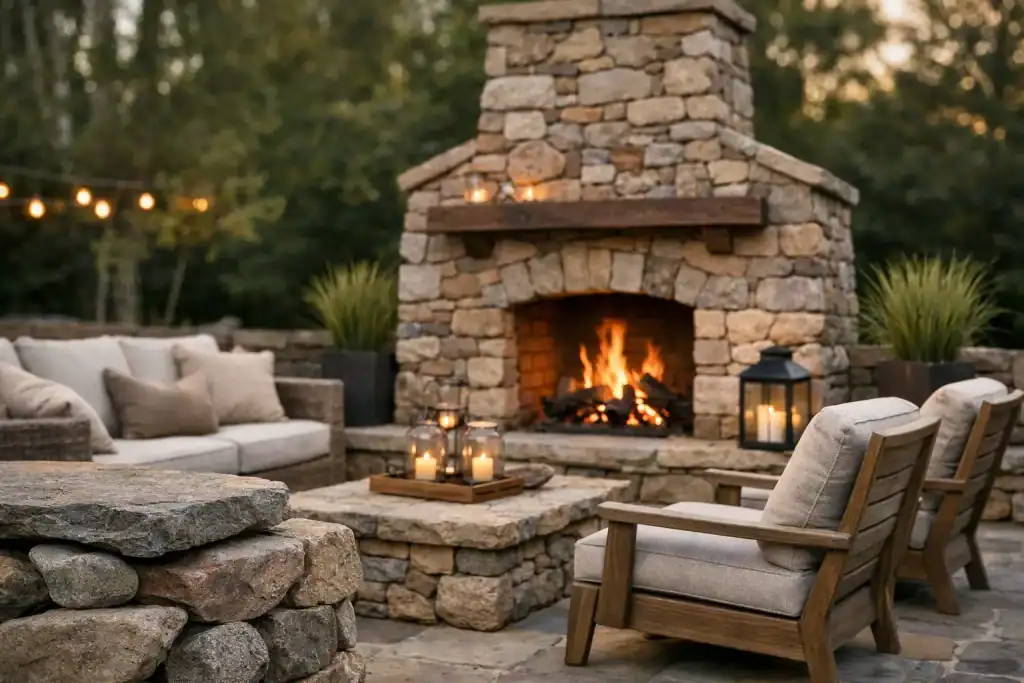
An outdoor fireplace should feel like an architectural destination, not a firebox placed at the edge of the patio. Learning how to style outdoor fireplaces begins with the experience you want to create around the flame: long lunches that continue after dark, a quiet place for winter evenings, or a dramatic focal point beside the pool.
The most successful schemes treat fire as one part of a considered outdoor room. Natural stone, paving, planting, seating and lighting all have a role in making the space feel resolved. The fireplace may draw the eye, but its surrounding materials determine whether it feels calm and enduring or visually disconnected from the home.
Start with the outdoor room, not the fireplace
Before selecting cladding or outdoor furniture, consider where the fireplace sits in relation to the home, landscape and entertaining areas. A fire feature positioned close to the dining zone can extend the use of a terrace through cooler months. One at the far end of a garden creates a destination and gives a larger site a stronger sense of depth.
Think about sightlines from inside, too. A fireplace viewed through large sliding doors can become a compelling evening feature, particularly when its stone finish echoes internal flooring, a feature wall or a hearth. This connection is what makes indoor and outdoor living feel intentional rather than separated.
Scale matters. A generous freestanding chimney can anchor a broad pool terrace or acreage setting, while a low linear fire may suit a contemporary courtyard where maintaining open views is the priority. The right proportion depends on the available wall plane, ceiling height, surrounding furniture and the visual weight of nearby materials.
For new builds, plan the fireplace alongside paving levels, drainage, services and roof coverage. In renovations, work with existing constraints rather than disguising them. A compact fire feature with excellent seating and lighting will usually feel more luxurious than an oversized structure that compromises circulation.
How to style outdoor fireplaces with natural stone
Stone gives an outdoor fireplace permanence. It also provides a natural bridge between architecture and landscape, particularly in Brisbane, the Gold Coast, Sunshine Coast and Northern Rivers homes where outdoor living is used across much of the year.
Choose the stone according to the architectural language of the property. A warm, textured wall cladding can bring depth to a relaxed coastal home or contemporary pavilion. Clean-cut, linear stone formats suit more tailored facades, while irregular crazy paving and rugged cladding can create a grounded, organic feel in a garden setting.
A fireplace does not need to be clad entirely in stone to make an impact. Consider a stone chimney breast paired with smooth rendered side walls, or a framed stone panel behind a linear gas fireplace. This approach can control cost and visual weight while retaining the tactile quality that makes natural materials so appealing.
Keep undertones aligned. Grey stone can read cool, charcoal or warm depending on its mineral variation and surrounding finishes. Likewise, creamy limestone tones may feel crisp beside pale timber and white render, or richer when combined with bronze metalwork and earthy planting. Take samples outdoors and view them in morning sun, shade and at night under artificial light before making a final selection.
The paving beneath and around the fireplace deserves equal attention. Matching the fireplace cladding exactly can create a monolithic result, while using a complementary paver often produces more depth. For example, a split-face wall cladding may sit beautifully above honed stone pavers in a similar colour family. The contrast is subtle but gives each surface a distinct purpose.
Build comfort into the layout
A fire draws people together, so seating should be arranged for conversation rather than simply facing the feature. Two sofas opposite one another with the fireplace at one end work well in a larger covered alfresco. In a smaller courtyard, a pair of generous lounge chairs and a compact side table may be all that is needed.
Leave enough room to move around the setting comfortably, particularly between the fire, dining table and access doors. Outdoor spaces often look generous in a plan but feel crowded once deep lounge furniture, side tables and planters are introduced. A clear circulation path makes the room more usable and allows the fireplace to remain a focal point.
Consider the heat source when choosing furniture placement. A wood fireplace provides atmosphere and radiant warmth, but it requires appropriate clearances, wood storage and a practical approach to ash. Gas offers immediate heat and a clean, controlled flame that suits frequent entertaining. Bioethanol and electric options can be useful where flues, gas connections or building constraints limit other choices, though each creates a different level of warmth and visual presence.
Weather protection is another practical consideration. Under a roofline, ensure the fireplace design and installation meet relevant requirements for clearances, ventilation and flueing. In an open landscape setting, prevailing wind can affect comfort and flame performance. Screens, planting and built edges can help shelter the zone without enclosing it too heavily.
Layer light, texture and planting
The fireplace supplies movement and warmth, but it should not be the only light source. Soft, layered lighting helps the outdoor room remain inviting before the fire is lit and after it has burned down. Wall lights can define the architecture, while discreet garden lighting reveals planting and creates depth beyond the terrace.
Avoid bright downlights directly above the fire seating area. They can flatten the mood and compete with the flame. Instead, use warmer, lower-level illumination around steps, paths and the perimeter of the space. The aim is safe movement and a gentle atmosphere, not a fully illuminated backyard.
Textiles add comfort, especially in hard-surfaced outdoor settings. Choose outdoor cushions, rugs and upholstery in tones that work with the stone rather than competing with it. Sand, clay, olive, charcoal and soft mineral shades tend to age gracefully and allow the flame to remain the visual centre.
Planting is equally effective in softening a fireplace structure. Architectural grasses, olive trees, layered shrubs or large sculptural pots can frame the feature and connect it to the garden. The best choice depends on the home’s setting and maintenance expectations. A coastal garden may call for resilient, wind-tolerant planting, while a lush subtropical landscape can support a more layered, immersive composition.
Keep planting at a safe distance from any open flame and choose pots and finishes that can tolerate heat, ash and changing weather. This is one area where practical restraint creates a more polished result.
Make room for the details that matter
The finishing details make an outdoor fireplace feel genuinely lived in. A built-in wood niche, a stone ledge for drinks, a nearby bench or a concealed storage zone can turn a feature into a functional gathering place. If the fireplace is wood-burning, integrate timber storage as part of the design rather than treating it as an afterthought.
For a poolside setting, consider how fire and water will work together after sunset. Stone coping, pool tiles, a fire feature and subtle landscape lighting can create a particularly compelling composition, but material selection needs to withstand splashes, sun exposure and regular cleaning. Slip resistance and maintenance should be considered alongside appearance.
Do not over-style the mantel or hearth. A few purposeful objects – a sculptural vessel, a lantern or a stack of neatly arranged timber – are often enough. Outdoor fireplaces are strongest when the architecture, flame and material variation are allowed to speak for themselves.
A considered fireplace gives an outdoor space a reason to be used after the sun goes down. Begin with the way you want to gather, select materials that belong to the architecture and landscape, and allow earth, fire and water to shape a setting that feels lasting rather than seasonal.